SA
Sports Awards GiftsMedal and award planning guides
EVENT AWARD GUIDES
Awards for a Family-Friendly 5K Without Competitive Podiums
A non-competitive event can still offer clear timing, finisher recognition, children’s awards, charity meaning, and an organized finish.

State what non-competitive means
A listing can say “no awards” while still offering chip time, a finisher medal, shirt, or children’s recognition. Clarify that there are no overall or age-group podiums rather than implying participants receive nothing.
Use the event awards guide to separate completion items from competitive places.
Design for mixed speeds
Strollers, walkers, children, first-time runners, and faster participants may share the course. Use waves, passing guidance, and a wide finish so different goals coexist safely.
Do not let the medal table narrow the chute or force families to stop immediately after the timing mat.
Choose age-appropriate recognition
Children may value a lightweight medal, ribbon, sticker, or certificate. Keep edges smooth, ribbons comfortable, and small detachable parts controlled.
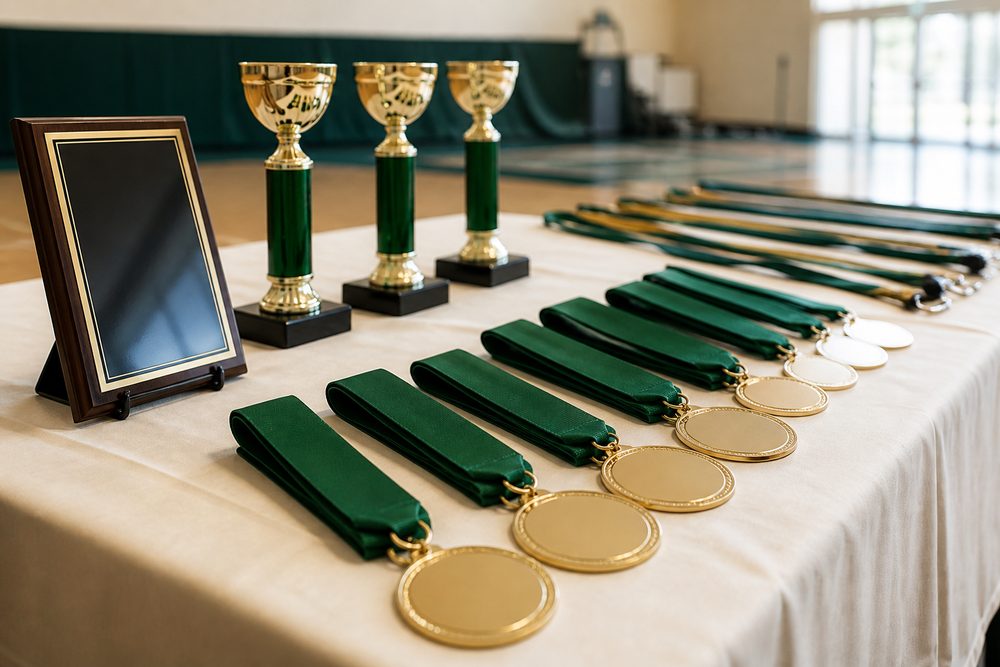
Compare lightweight colorful PVC awards for children with simple stock medals for broad participation.
Connect the award to the cause
If entry supports charity, explain where funds go and keep the medal design respectful. The cause should not become a decorative slogan without transparent information.
A short card or results email can explain impact more clearly than crowding the medal face.
Keep timing and recognition distinct
Chip timing can help participants track progress without creating official podiums. Publish alphabetical results or personal lookups when ranking is not central.
State whether course records, fastest times, or social posts create any award eligibility. Consistency avoids surprise ceremonies.
Plan an inclusive finish
Train volunteers to congratulate without judging pace. Keep water, medical observation, medal handoff, and family reunion easy to find.
Survey walkers, parents, children, and faster runners separately. Their operational needs differ even when everyone receives the same completion item.
Put the decision into the event brief
Before approval, record the participant promise, responsible lead, artwork or material specification, order quantity, verification point, exception route, communication deadline, and evidence retained after the event. Registration, timing, awards, volunteer, and support teams should sign the same version instead of relying on separate assumptions.
Test one normal participant journey and one difficult exception with staff who did not write the plan. Confirm that they can identify the correct action, document it, and escalate it without guessing. Store the final brief with supplier proofs and result records for the next edition.
Review evidence before repeating the format
Within two weeks, compare participant questions, finish photographs, volunteer notes, distribution counts, damaged items, replacements, unclaimed stock, and supplier issues. Separate personal taste from repeated operational failure, but do not dismiss a small number of detailed cases when they reveal a clear control problem.
Assign each accepted improvement an owner and deadline before registration reopens. Update public wording, artwork files, order calculations, training notes, and claim forms together. This closes the gap between a good idea on paper and the experience runners actually receive.
Rehearse the participant journey before opening day
Use final signs, sample awards, cartons, forms, and staff positions to run a short simulation. Include an ordinary finisher, a wrong-distance case, a damaged item, a participant needing assistance, and a question that requires escalation. Time both the normal flow and the exception path so one difficult case cannot block everyone behind it.
Correct labels, stock locations, scripts, and ownership while the venue is still quiet. Photograph the approved setup and give shift leaders the same reference. A brief rehearsal turns written policy into repeatable behavior and reveals practical conflicts that artwork proofs and planning calls cannot show.
Check delivery against the approved sample
Inspect pieces from several cartons before they reach the venue. Compare artwork, finish, ribbon, attachment, labels, quantity, and packing with the signed control sample. Record defects by batch and isolate questionable stock instead of mixing it into active inventory.
Confirm correction options and deadlines with the supplier while there is still time to act. Early inspection protects volunteers from discovering a preventable quality or labeling problem in front of participants.
Topic references: a discussion of a family 5K with medals but no competitive awards and a runner question about finding 5K and 10K events with finisher medals.
Related Guides
Keep the award brief moving.
 Medal GuideCustom Medal Guide
Plan size, quantity, finish, ribbon, packaging, and order timing.
 DesignMedal Design Ideas
Shape the medal around artwork, readable copy, and event identity.
 MaterialsMaterials and Finishes
Compare metal, enamel, PVC, antique, plated, and printed options.
EventsEvent Award Guides
Organize award systems for races, schools, clubs, and meet days.
发表回复