Event award guides
End-of-Season Sports Awards: Build a Ceremony That Feels Fair
A good awards ceremony recognizes effort, results, growth, and service without turning every category into the same prize.

Why fairness matters at the end of a season
Track and youth sports communities often discuss performance, medals, rankings, and what recognition means. At school and club level, the same issue becomes practical: how do you reward achievement without making the ceremony feel political, too expensive, or confusing?
An end-of-season ceremony needs structure before products are ordered. The event award guides page is a useful starting point because it separates event type, award purpose, quantity, and handout flow.
Separate results from growth
Competitive results should be recognized clearly. Top finishers, championship teams, relay winners, point scorers, and record setters may deserve medals or trophies. But youth and school programs also need room for improvement, attendance, leadership, sportsmanship, and service.
Those categories should not all look the same. Results-based awards can be medals or trophies. Growth-based awards can be certificates, plaques, ribbons, or smaller keepsakes. Clear separation helps athletes understand what each recognition means.
Use medals for achievement moments
Medals work well for race placements, meet results, tournament finishers, team relays, and participation milestones. They are easy to distribute, easy to photograph, and familiar to athletes. For a program with a recurring visual identity, custom medals for school and club events can carry the season year, team mark, or event name.
For younger athletes or colorful team themes, lightweight PVC medals for youth recognition can be more comfortable and visually flexible than heavy metal.
Reserve trophies and plaques for fewer categories
Trophies become more meaningful when they are selective. Use them for champions, MVPs, team awards, season records, or coach-selected top honors. Plaques are useful for sponsors, coaches, graduating athletes, and club leadership. If every category receives a trophy, the ceremony becomes longer and less clear.
For captains, volunteers, or long-service recognition, coin-style awards for special roles can create a smaller but thoughtful moment.
Plan the order of presentation
The ceremony should have a rhythm. Start with broad participation or appreciation, then move into team categories, then performance awards, then special honors. This prevents the event from feeling like a random list of prizes.
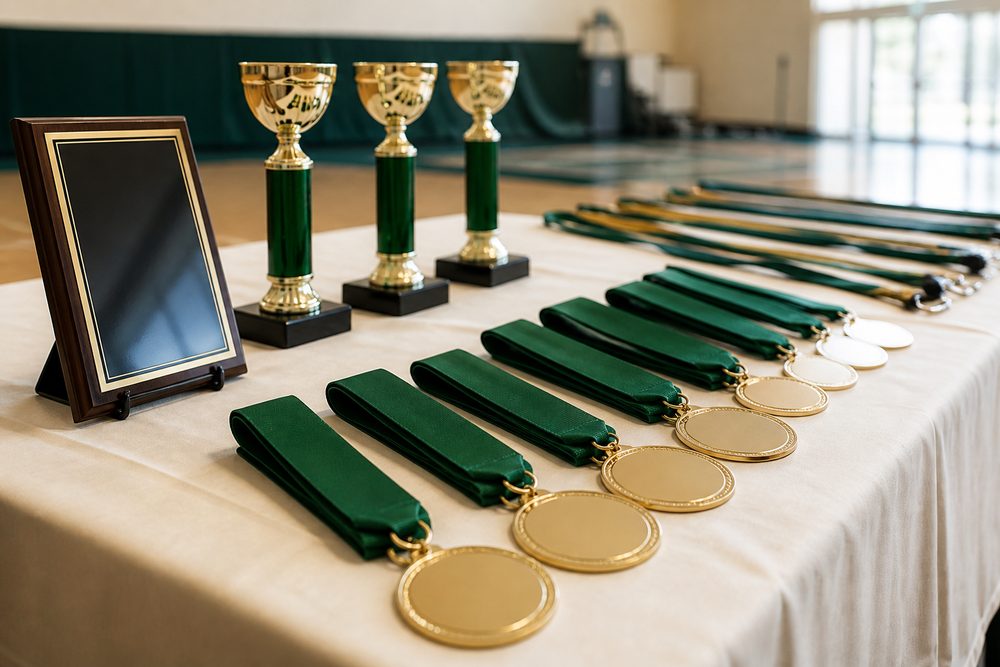
Prepare the table before the audience arrives. Sort awards by category and presentation order. Label cartons and envelopes. Assign one person to read names and another to hand awards to the presenter. Small details keep the ceremony calm.
Write category language carefully
Award names should be specific and respectful. Best Sprinter, Most Improved, Team Leadership, Sportsmanship, Consistent Attendance, Relay Contributor, Field Event Standout, and Coach’s Recognition all tell different stories. Clear names reduce confusion and help families understand the purpose.
If awards are coach-selected, state that clearly. If awards are based on results, use verified results. If awards are participation-based, make that explicit. Fairness often comes from language as much as the award object.
Control cost without weakening meaning
Not every recognition moment needs the same product. Use stock medals or ribbons for broad categories, custom medals for recurring program identity, trophies for major achievements, plaques for formal service, and coins for small special roles. If budget is tight, presentation and clarity matter even more.
Before ordering, use the custom medal order checklist to confirm names, quantities, artwork, ribbon colors, packaging, and ceremony date.
Topic references: track and field community discussions around medals and performance and running community conversations on awards and event value.
发表回复